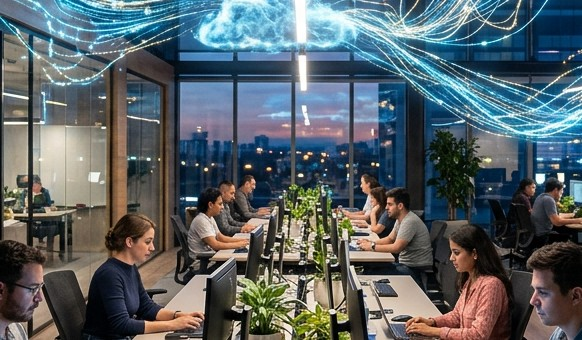
Invisible AI infrastructure is now central to Human Resource Management Systems, quietly determining how companies find, manage, and develop their people. Walk into any modern office, and you’ll see the usual suspects: laptops, coffee, maybe a standing desk or two. What you won’t see, at least not directly, is the AI humming quietly in the background. Human Resource Management Systems (HRMS) used to mean a few spreadsheets and a filing cabinet. Now, they’re complex digital frameworks, and artificial intelligence is the silent engine making them smarter every day.
Most employees probably don’t realize how much AI touches their experience from day one. Take the hiring process, for example: it’s a maze of data. Resumes, cover letters, online assessments—thousands can flood in for a single role. Instead of teams spending weeks sorting through stacks of applications, AI-driven applicant tracking systems scan and rank candidates in seconds. The algorithms look for keywords, relevant experience, and even patterns in career progression that a human might miss. It’s not simply about speed, though; it’s about surfacing the right people from a sea of possibilities.
But AI in HR isn’t just about hiring. Once someone joins, AI quietly begins onboarding. Intelligent chatbots answer questions about benefits, company policy, or where to find that elusive health insurance form. New hires get personalized onboarding schedules, are nudged to complete tasks, or are prompted to sign up for training. For the company, this implies fewer dropped balls and a more seamless ramp-up for each employee. For the new hire, it means less confusion and more confidence from the start.
Performance management represents another area where AI’s fingerprints are everywhere. Instead of annual reviews based on hazy memories and gut feelings, AI can track performance measures year-round. It analyzes project outcomes, peer feedback, and even communication behaviors. This gives managers a real-time, data-driven picture of how the team is doing. The result? More objective reviews, better coaching, and fewer surprises when it comes time for promotions or raises.
Employee engagement has always been tricky to measure. People say what they think their boss wants to hear, and by the time someone is ready to quit, it’s often too late to fix what’s wrong. AI helps here too. Sentiment analysis tools scan employee surveys, emails, and chat logs (anonymously and ethically, if the company is doing it right) to spot signs of burnout, frustration, or low morale. HR teams can then step in proactively, sometimes before a problem even surfaces.
AI is also changing the way companies oversee scheduling and workforce planning. Predictive analytics can forecast busy periods or possible bottlenecks, helping managers assign shifts or projects more efficiently. For industries with hourly workers, this leads to fewer eleventh-hour rushes and more consistent coverage. For employees, it can mean fairer schedules and less stress about sudden changes.
Training and development have gotten an overhaul as well. Adaptive learning platforms apply AI to assess an employee’s strengths and weaknesses and design personalized training paths. Someone struggling with Excel might get extra tutorials, while another employee breezes ahead to more advanced topics. This promises to close skills gaps faster and keep workers engaged with learning that actually feels relevant.
Of course, all this AI magic raises some thorny questions. There exist concerns about bias in algorithms, especially in hiring. If an AI is trained using historical data, it can unintentionally perpetuate old patterns, favoring certain backgrounds or schools. The best HR teams keep a close eye on these systems, constantly checking for equity and openness. There’s also the question of privacy—how much should a company know about its workers, and what data should be off-limits?
In spite of the challenges, invisible AI infrastructure is likely to become even more central as HR teams contend with hybrid work, global teams, and an ever-more complicated regulatory environment. The systems will keep getting better at predicting what people want, what they need, and what might make them leave for a competitor.
For most employees, the goal is not to be managed by a machine, but to have their human experience supported by smarter, more interactive systems. When AI is working right, it doesn’t seem intrusive. It’s the difference between a clunky bureaucratic process and one that actually helps you get your work done.
The paradox is that the most powerful technology in HR right now is also the most invisible. As AI continues evolving, the line between what’s automated and what’s human will keep shifting. But the takeaway is clear: AI is not replacing the human side of HR; it is supporting it by making everyday processes smoother, fairer, and more responsive. Behind every flawless onboarding, fair review, or perfectly timed training nudge, there’s almost certainly an algorithm at work—quietly making HR a little more human, one piece of code at a time.